Managing Common Cause Failure in SIL Verification
Common cause failure occurs when multiple components fail because of a shared cause rather than independent failures occurring separately.
Within functional safety and SIL verification activities, common cause failure is important because it can reduce the effectiveness of redundant architectures that are intended to improve reliability and risk reduction.
Examples of common cause failure may include:
- environmental conditions
- power supply failures
- incorrect maintenance activities
- design errors
- configuration mistakes
- human error
For broader lifecycle verification background, review our SIL Verification guide.
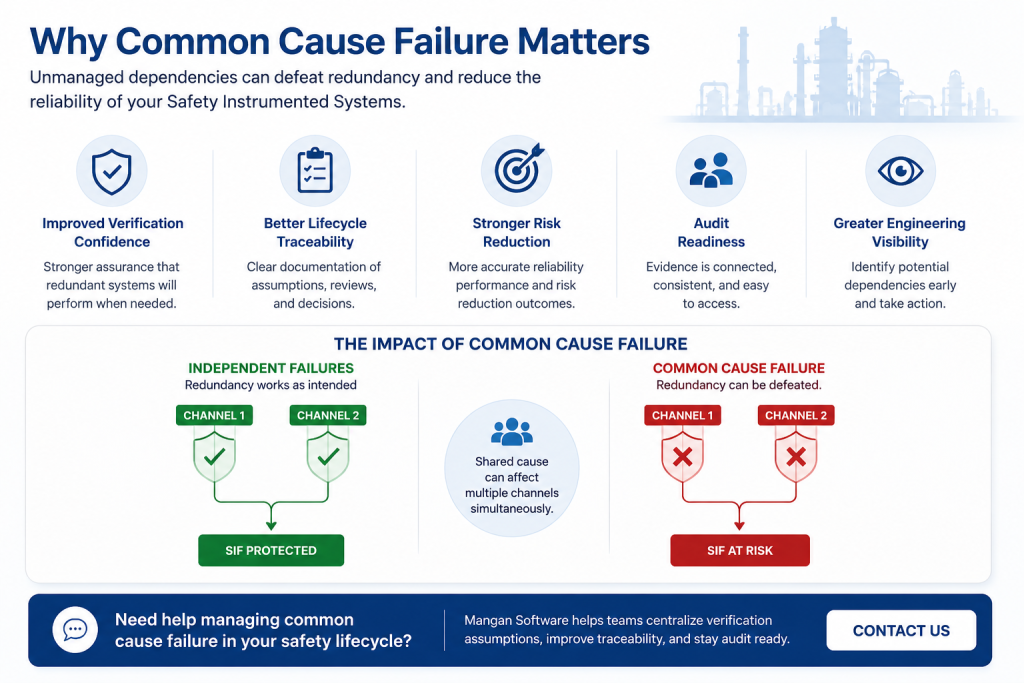
Why Common Cause Failure Matters
Redundant systems are often implemented to improve reliability and reduce the probability of dangerous failures.
However, if multiple channels can fail from the same underlying cause, the expected reliability improvement may be significantly reduced.
Managing shared-cause failure helps organizations improve:
- verification confidence
- lifecycle traceability
- risk reduction performance
- audit readiness
- engineering visibility
- compliance management
Organizations commonly review potential dependency risks throughout the safety lifecycle to ensure redundancy assumptions remain realistic.
Understanding Common Cause Failure in Redundant Systems
Many Safety Instrumented Functions use redundant architectures to improve reliability.
Examples may include:
- dual sensors
- redundant logic solvers
- multiple final elements
- backup communication paths
- diverse protection systems
If these components share a common weakness, a single event could affect multiple channels simultaneously.
Managing these dependencies is an important part of lifecycle verification and engineering review activities.
Common Cause Failure and PFDavg Calculations
Common cause failure assumptions are often included within PFDavg calculations because failure dependencies can influence overall safety function performance.
Engineering teams commonly review:
- beta factor assumptions
- equipment diversity
- maintenance practices
- environmental influences
- failure history
- architecture design choices
Reliable lifecycle records help organizations maintain consistency between verification assumptions and reliability calculations.
For more reliability calculation background, review our PFDavg guide.
Common Cause Failure and SIL Verification
SIL verification activities often include reviews of dependency assumptions that could affect the reliability of redundant systems.
Organizations commonly assess:
- shared power supplies
- common environmental exposure
- maintenance procedures
- design consistency
- testing practices
- human factors
Maintaining connected lifecycle records helps organizations improve traceability between verification assumptions and operational activities.
For additional reliability background, review our Diagnostic Coverage Explained guide.

Supporting IEC 61511 Lifecycle Compliance
IEC 61511 requires organizations to manage safety lifecycle activities using documented engineering processes and verification practices.
Managing shared-cause failure helps support:
- verification consistency
- engineering accountability
- lifecycle governance
- audit readiness
- risk management
- compliance visibility
For official standards information, visit the IEC website.
Reducing Dependency Risks Through Good Design
Engineering teams often implement measures to reduce the likelihood of common cause failure affecting multiple channels simultaneously.
Examples may include:
- equipment diversity
- physical separation
- independent power supplies
- segregated communications
- independent testing procedures
- separate maintenance strategies
These approaches help strengthen redundancy assumptions and improve confidence in lifecycle reliability calculations.
Linking Common Cause Failure to Proof Testing
Testing activities can help organizations identify weaknesses that may increase the likelihood of dependent failures.
Organizations commonly review:
- testing procedures
- maintenance records
- equipment history
- failure investigations
- repair activities
- verification assumptions
Connected lifecycle workflows help teams improve traceability between testing activities and reliability assessments.
For more lifecycle testing background, review our Proof Testing guide.
Managing Engineering Records More Effectively
Many organizations still manage dependency assumptions using spreadsheets, disconnected systems, and manual engineering records.
This can create challenges such as:
- duplicate documentation
- manual audit preparation
- limited cross-team visibility
- version control issues
- poor lifecycle traceability
- inconsistent engineering records
As lifecycle complexity grows, maintaining reliable dependency records manually can become increasingly difficult.
Improving Traceability Across the Lifecycle
Structured lifecycle management software can help organizations centralize verification assumptions, engineering records, testing evidence, and lifecycle approvals within a connected environment.
This may improve:
- engineering visibility
- workflow consistency
- audit readiness
- cross-discipline collaboration
- document traceability
- compliance reporting
For broader lifecycle workflow context, explore our Functional Safety Management Software guide.
Linking Common Cause Failure to Safety Requirements
Dependency assumptions should remain aligned with the requirements defined during the safety lifecycle.
Organizations commonly review:
- SIL targets
- architecture assumptions
- verification calculations
- testing strategies
- maintenance procedures
- operational requirements
For additional lifecycle requirements background, review our Safety Requirements Specification (SRS) guide.
Supporting Long-Term Reliability and Compliance
Common cause failure remains an ongoing consideration throughout the operational lifecycle because equipment, maintenance strategies, environmental conditions, and operational requirements may change over time.
Organizations commonly review lifecycle information during:
- management of change activities
- equipment replacement projects
- verification reviews
- testing strategy updates
- compliance audits
- continuous improvement initiatives
Maintaining connected lifecycle records helps organizations improve long-term reliability, governance, and operational safety management across functional safety activities.


