
SLM Memcached Maintenance Guide
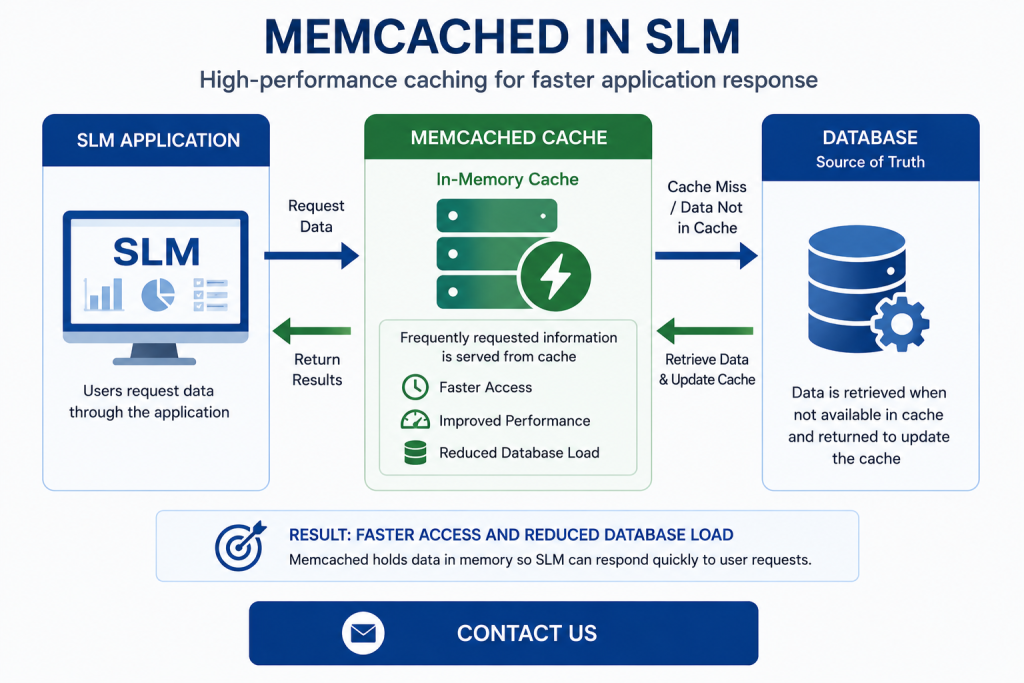
SLM Memcached maintenance helps administrators manage the caching service used by Safety Lifecycle Manager to improve application performance. Memcached provides a high-performance memory-based caching mechanism that can reduce the need to repeatedly retrieve information from the database.
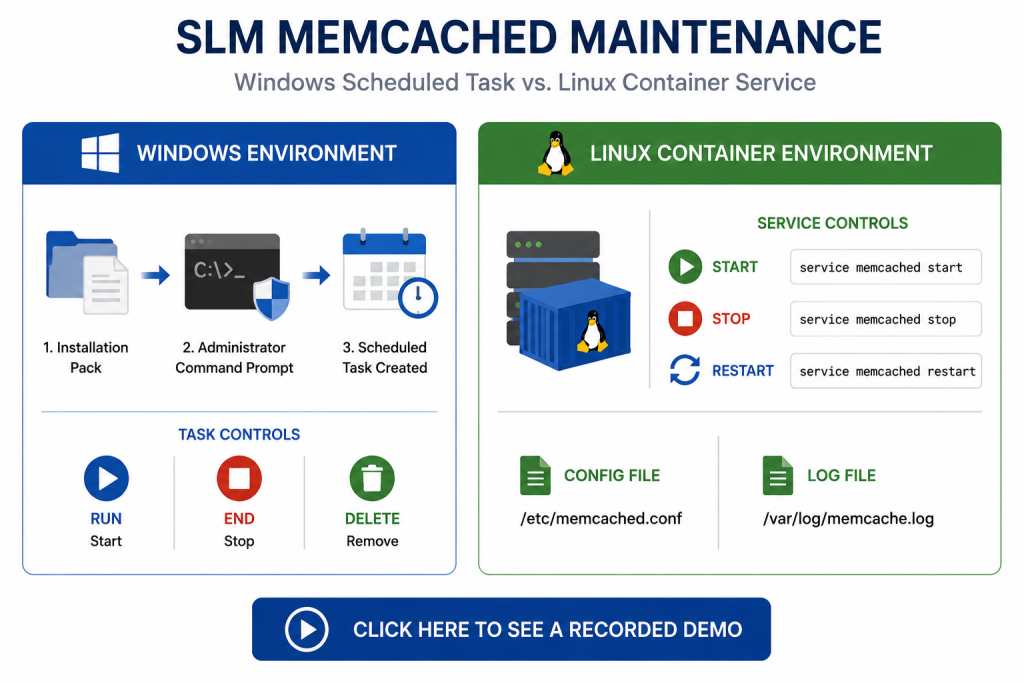
Within the SLM environment, the maintenance procedures differ depending on whether Memcached is operating on Windows or within a Linux container. Windows administration involves installing and controlling a scheduled task, while the Linux container includes Memcached as part of its setup and provides service commands for starting, stopping and restarting it.
This guide covers SLM Memcached maintenance for both environments, including Windows installation and task management, Linux service controls, configuration settings and log-file locations.
How Memcached Supports the SLM Environment
SLM uses Memcached as its caching tool to help speed up the application. Memcached is a distributed memory object caching system designed to improve the performance of dynamic applications by reducing database load.
Instead of requiring the application to retrieve the same information repeatedly from its underlying data source, caching allows appropriate information to be held temporarily in memory for faster access.
Within SLM, Memcached therefore forms part of the supporting application infrastructure rather than acting as a user-facing SLM function.
Memcached is also identified as part of the SLM Web App server environment in the SLM On-Premise Hardware and Software Requirements guide.
SLM Memcached Maintenance on Windows
SLM Memcached maintenance on Windows includes installation and the ability to start, stop and remove the Memcached scheduled task.
The training uses two files supplied as part of the SLM installation pack. Once the supplied folder has been extracted, the installation process is performed through an elevated Windows Command Prompt.
The Command Prompt must be opened with administrator permissions before the supplied installation commands are executed.
The demonstrated process is:
- Extract the Memcached files supplied with the installation pack.
- Open Command Prompt using Run as administrator.
- Execute the first command supplied in the installation documentation.
- Confirm that the Memcached scheduled task has been created successfully.
- Execute the supplied run command to start Memcached.
The exact Windows commands should be taken from the MSS installation documentation supplied with the installation package rather than recreated manually from this overview.
Starting and Stopping Memcached on Windows
After installation, the Windows Memcached scheduled task can be controlled using the commands provided with the SLM installation documentation.
The training demonstrates three administrative actions:
- Run – starts the Memcached scheduled task.
- End – stops the running Memcached scheduled task.
- Delete – removes the Memcached scheduled task.
When the delete operation is used, Windows requests confirmation before removing the scheduled task. In the demonstrated procedure, the administrator confirms the deletion before the task is removed.
These controls allow administrators to manage the Windows implementation without changing the underlying purpose of Memcached within SLM.
Managing Memcached in a Linux Container
In the Linux container environment demonstrated in the training, Memcached is already installed as part of the setup. SLM Memcached maintenance therefore focuses on controlling the existing service rather than performing the Windows-style installation process.
The service can be started using:
service memcached startIt can be stopped using:
service memcached stopTo restart the service, use:
service memcached restartThese commands allow an administrator to control the Memcached service from within the Linux environment.
Memcached Configuration and Log Files
The Linux container also provides access to the Memcached configuration file and application log.
The configuration file demonstrated in the training is:
/etc/memcached.confThe example uses Vim to open this configuration file for review or editing.
The Memcached log file is located at:
/var/log/memcache.logThe configuration demonstrated in the SLM training includes:
- Default memory configuration
- Default Memcached port
- Memcache username
- Local IP address 127.0.0.1
- A PID file used to run Memcached
These values describe the Linux container configuration shown in the training. Administrators should use the configuration supplied for their SLM deployment rather than assuming that settings from another Memcached installation should be substituted.
Windows and Linux Maintenance Differences
The principal difference between the two SLM Memcached maintenance workflows is how the service is deployed and controlled.
On Windows, the training demonstrates creating and managing Memcached as a scheduled task using commands supplied with the installation package.
Within the Linux container, Memcached is already installed as part of the deployed setup. Administrators therefore use Linux service commands to start, stop or restart it and can access the configuration and log files directly within the container.
The two approaches can be summarized as follows:
- Windows: supplied installation files, elevated Command Prompt and scheduled-task management.
- Linux container: preinstalled Memcached, service management and direct configuration/log access.
Understanding which environment is being maintained is therefore important before performing any Memcached administration.
Troubleshooting SLM Memcached
When investigating SLM Memcached maintenance issues, administrators should first establish whether the deployment uses the Windows scheduled-task approach or the Linux container implementation.
For Windows, the administrator can confirm whether the scheduled task was created successfully and whether it is currently running.
For the Linux container, administrators can use the appropriate service controls and review the Memcached configuration and log file where necessary.
Application troubleshooting may also require reviewing information outside the caching service itself. The SLM Application Maintenance guide covers IIS W3C and SLM PHP application logs that can provide additional evidence when investigating application behaviour.
The official Memcached documentation provides additional background on Memcached architecture and administration. SLM-specific installation and configuration should continue to follow the MSS-supplied installation package and documentation.
Maintaining Memcached as Part of SLM
SLM Memcached maintenance should be treated as part of the wider administration of the SLM application environment. The caching service supports application performance, while its implementation and administrative controls depend on the operating environment.
On Windows, administrators can install and manage Memcached through the scheduled-task process supplied with SLM. In the Linux container, Memcached is already installed and can be managed using the available service commands.
The Linux configuration and log files also provide administrators with access to the settings and operational records demonstrated in the training.
By understanding these environment-specific controls, administrators can perform SLM Memcached maintenance without confusing Windows scheduled-task administration with the service-based approach used by the Linux container.
Maintenance Tools – Memcached
0:06
Welcome to this IT Explainer video, part of our Maintenance Tools topic range.
0:11
In this video we’ll cover the subject of Memcached in SLM.
0:16
SLM leverages memcached as its caching tool to speed up the application.
0:20
Memcached is a high performance distributed memory object caching system, generic in nature, but originally intended for using speeding up dynamic web applications by alleviating database load.
0:34
The following information will be covered in this training.
0:36
Chapter one will be Memcached on Windows, and chapter 2 will be Memcached on Linux container.
0:47
In chapter 1 we’ll cover installation, starting, stopping and uninstallation in Windows.
0:54
For this exercise, we’ll need the following two files.
0:57
These will be provided to you with the installation pack.
1:00
So once we have the folder extracted, we’ll open up a command prompt.
1:04
This needs to be in elevated permissions.
1:07
So if we right click and click Run as administrator and then we have a couple of commands that we need to type in, but this will be provided to you.
1:14
You can simply copy and paste these two commands into the command prompt.
1:25
So this is the first command that’s provided in the documentation.
1:29
So once you’ve copied and pasted this, you just need to hit enter and you can see it’s successful.
1:34
The scheduled task memcached has successfully been created and then to run the memcached we need to copy and paste the second command.
1:45
So this will run the memcached.
1:47
Now that to stop it, there’s a command to stop instead of run.
1:51
We just edit this command and put end and hit return and we can see this has successfully stopped the command.
1:59
And if we need to remove the task, we just change end to delete, hit return.
2:08
It asks if you’re sure you want to delete, just type Y and hit return.
2:12
And now memcached was successfully deleted.
2:18
In Chapter 2 we will cover starting, stopping, restarting, and the configuration file in Linux.
2:26
Memcached in the Linux container is already installed in the setup.
2:29
So we’re just going to look at how to Start, Stop and restart memcached.
2:35
So to start memcached we just type service space memcached space start and we can see that started the memcached.
2:44
To stop the memcached we change this to stop and hit return and to restart it’s service memcached restart.
2:53
It’s just restarted now.
2:54
Now to edit the config file of the memcached, let’s just clear the screen.
2:59
So to edit the memcached config file we go to vim etc.
3:06
Memcached dot conf.
3:08
When the container image is deployed, it’s all already there for you.
3:11
But the log file is located in this directory var log memcache dot log.
3:18
The memory is default, the port is default.
3:21
Username is memcache.
3:23
The IP address for the memcache server is just a local IP address, so it’s 127.0.0.1 and we’re using a PID file to run the memcached and that’s all the required information for the memcached container.


