What Is LOPA? Layer of Protection Analysis Explained
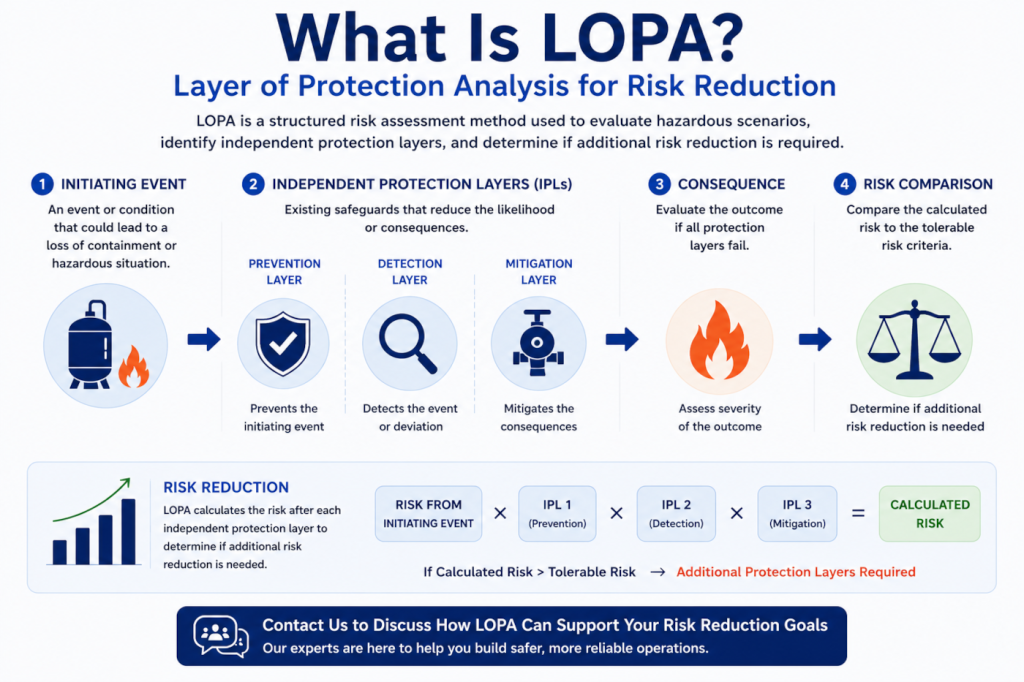
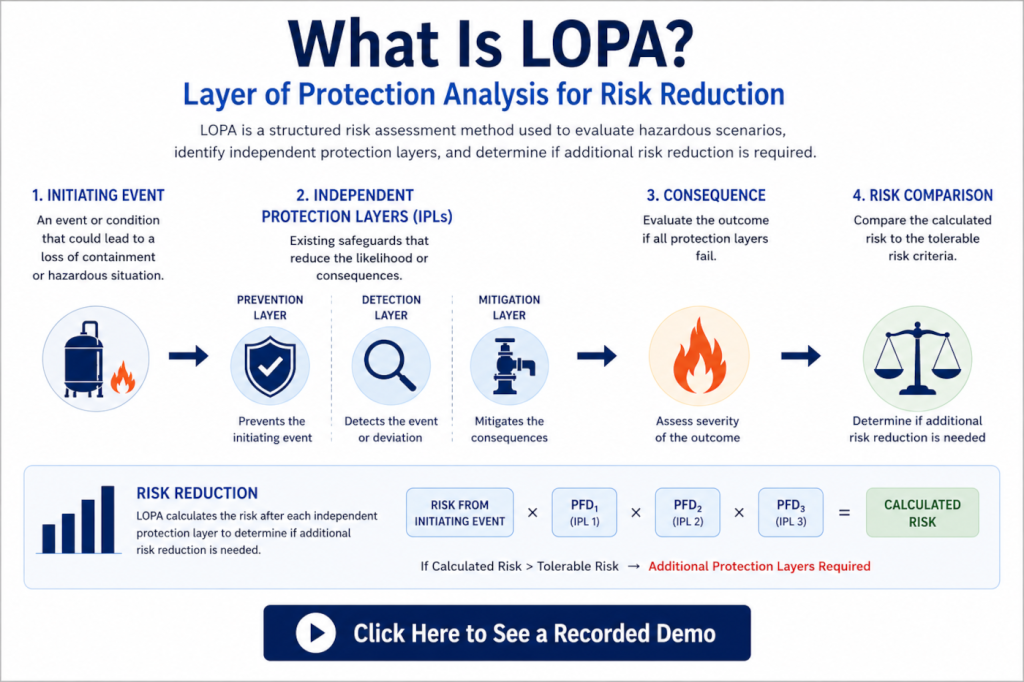
Layer of Protection Analysis (LOPA) is a structured risk assessment method used in process safety and functional safety industries.
It helps organizations evaluate hazardous scenarios, identify independent protection layers, and determine whether additional risk reduction is required.
LOPA is commonly used to support Safety Integrity Level (SIL) determination and wider safety lifecycle decisions.
What is LOPA and How Does It Work?
LOPA is designed to bridge the gap between qualitative hazard reviews and quantitative risk assessment methods.
For further industry context, see this Layer of Protection Analysis guidance from CCPS,
which explains LOPA as a simplified process risk assessment method.
The process evaluates:
- initiating events
- consequence severity
- existing safeguards
- independent protection layers (IPLs)
- required risk reduction
This allows engineering teams to determine whether current safeguards are sufficient or whether additional protection is needed.
Why What Is LOPA Matters for Risk Reduction
Process facilities often operate with complex hazards and multiple layers of protection.
A structured assessment approach helps organizations:
- reduce operational risk
- improve consistency
- support compliance efforts
- strengthen audit readiness
- improve decision-making
Without a formal process, hazard evaluations can become inconsistent and difficult to manage across the lifecycle.
How Layer of Protection Analysis Supports SIL Determination
One of the most common uses of Layer of Protection Analysis is supporting SIL target definition.
LOPA outputs are frequently used to identify the amount of risk reduction required for safety instrumented functions.
For a deeper explanation of how risk reduction requirements are translated into SIL targets, explore our SIL determination guide.
You can explore this process further in our:
Common Challenges with Spreadsheet-Based Studies
Many organizations still manage hazard assessments and risk reduction studies using spreadsheets.
This can create issues such as:
- version control problems
- fragmented data
- inconsistent reporting
- limited traceability
- disconnected lifecycle information
As facilities become more complex, spreadsheet-based management becomes increasingly difficult to maintain.
Common Challenges with SIL Management
Many organizations still rely on spreadsheets to manage SIL calculations and lifecycle records.
This can create challenges such as:
- Version control issues
- Limited traceability
- Manual calculation errors
- Difficulty managing changes
- Inconsistent reporting
As facilities grow more complex, these risks increase significantly.
Moving Beyond Manual LOPA Management
Modern process safety teams increasingly use connected software platforms to manage hazard studies, recommendations, and lifecycle data.
This allows organizations to:
- Maintain a centralized system
- Improve collaboration
- Connect studies to lifecycle activities
- Strengthen traceability
- Improve reporting consistency
You can also explore our: SIS lifecycle guide
Related Functional Safety Topics
Additional guides:


