
What Is SIL Verification?
SIL verification is the process of confirming that a safety instrumented function (SIF) can achieve the required Safety Integrity Level (SIL) assigned during risk assessment and SIL determination.
Within IEC 61511 projects, SIL verification helps demonstrate that the proposed design, architecture, proof test interval, failure rates, and diagnostic coverage are suitable for the required risk reduction.
The goal is to confirm that a safety function is not only required, but also capable of meeting its target performance throughout the functional safety lifecycle.
For background on how SIL targets are assigned, explore our SIL Determination Explained guide.
Why SIL Verification Matters
SIL verification is a critical step between SIL determination and detailed safety system implementation.
Without proper verification, organizations may struggle to confirm whether a safety instrumented function can meet its required integrity target.
This can create issues such as:
- incorrect assumptions about risk reduction
- unsupported SIL claims
- incomplete lifecycle documentation
- poor audit traceability
- design gaps between risk assessment and implementation
- inconsistent verification records
A structured verification process helps engineering teams confirm that the selected devices, architecture, and testing strategy support the required safety performance.
Proof test coverage assumptions help organizations estimate how effectively dangerous undetected failures can be identified during lifecycle testing activities. Learn more in our Proof Test Coverage Explained guide.
How SIL Verification Fits into the Safety Lifecycle
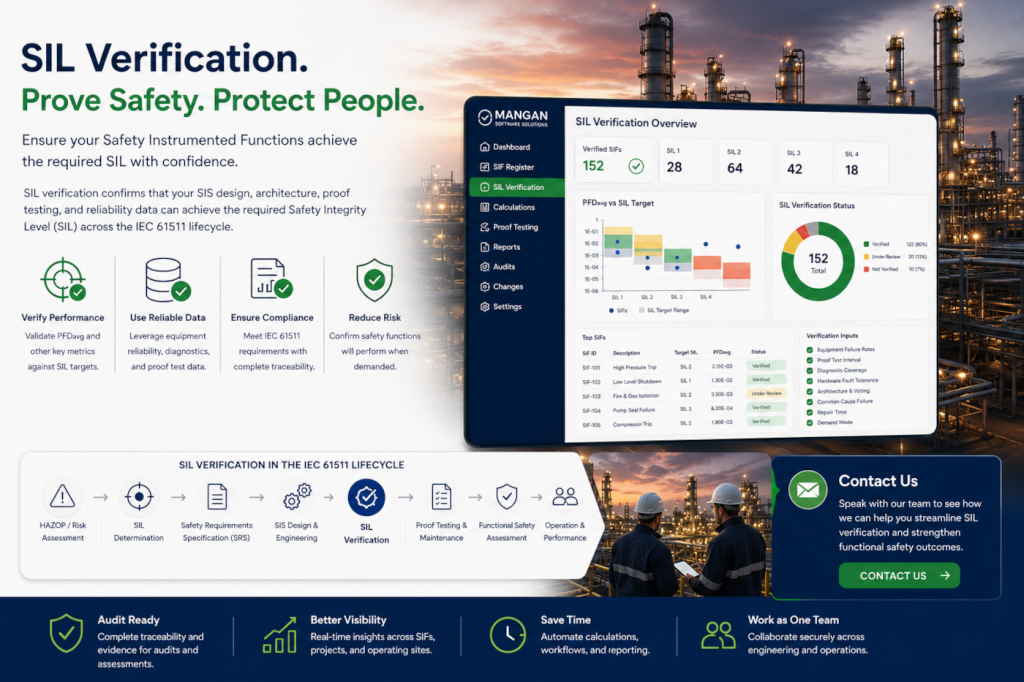
SIL verification supports the wider functional safety lifecycle by checking that safety instrumented functions are designed to meet their required performance targets.
The process is closely connected to:
- hazard and risk assessment
- LOPA analysis
- SIL determination
- Safety Requirements Specification development
- SIS design and engineering
- proof testing strategy
- functional safety assessment
Lifecycle modifications can affect SIL assumptions, verification records, and testing strategies, making Management of Change processes essential for maintaining compliance visibility. Learn more in our Management of Change (MOC) guide.
Functional Safety Assessments often review SIL verification records, lifecycle evidence, and supporting documentation to confirm that safety activities have been completed correctly. See our Functional Safety Assessment (FSA) guide.
The verification results should remain connected to the safety lifecycle so that future changes, testing updates, and management of change activities can be reviewed consistently.
For more lifecycle context, see our IEC 61511 guide.
Key Inputs Used for SIL Verification
SIL verification normally requires engineering data from several parts of the safety lifecycle.
Typical inputs include:
- required SIL target
- safety instrumented function description
- equipment failure rate data
- proof test interval
- diagnostic coverage
- hardware fault tolerance
- common cause failure assumptions
- voting architecture
- repair time assumptions
- demand mode assumptions
Redundancy assumptions and dependency risks are important considerations during SIL verification because common cause failures can affect the reliability of multiple protection channels. Learn more in our Managing Common Cause Failure in SIL Verification guide.
Diagnostic coverage is one of the key inputs used during SIL verification because fault detection assumptions can affect whether a safety function meets its required target. Learn more in our Diagnostic Coverage Explained guide.
These inputs depend on the sensors, logic solvers, final elements, and architecture used within each safety function. For more detail, see our Safety Instrumented Function (SIF) guide.
The quality of these inputs directly affects the reliability of the verification result.
SIL Verification and IEC 61511 Compliance
IEC 61511 requires organizations to verify that safety instrumented functions are capable of meeting the required SIL.
This means engineering teams must be able to demonstrate that the selected design can achieve the necessary risk reduction before implementation and throughout lifecycle operation.
SIL validation is the next practical step after verification, helping teams confirm that the installed safety function performs correctly before operation. Learn more in our SIL Validation Explained guide.
An effective verification process supports:
- clear design justification
- consistent calculation records
- traceability to the Safety Requirements Specification
- evidence for audits and assessments
- controlled updates when changes occur
For official functional safety standards information, visit the IEC Functional Safety overview.
Understanding PFD and Probability of Failure on Demand
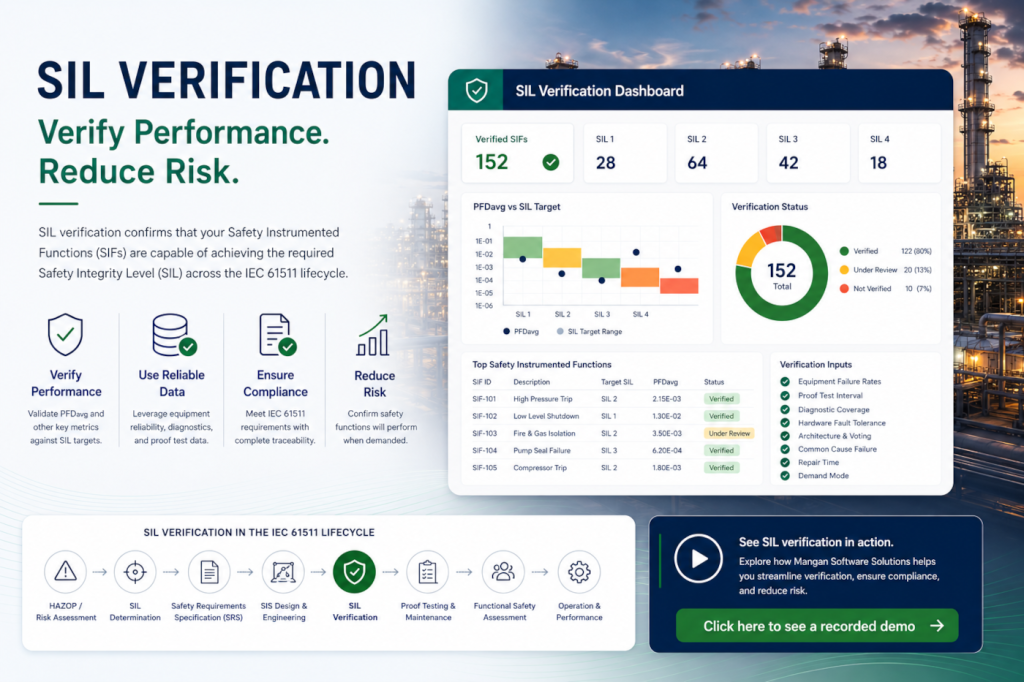
For low-demand safety instrumented functions, SIL verification often involves calculating the average Probability of Failure on Demand (PFDavg).
PFDavg helps estimate whether a safety function is likely to perform when required.
Logic solvers are commonly included within SIL verification calculations because controller reliability and architecture assumptions directly affect safety function performance. Review our Logic Solvers in Functional Safety Explained guide.
Typical factors that influence PFDavg include:
- component reliability
- proof test frequency
- test coverage
- architecture
- repair time
- diagnostics
- common cause failure assumptions
Many of these assumptions depend on effective proof testing intervals and accurate maintenance records throughout the operational lifecycle. Learn more in our Proof Testing guide.
The calculated PFDavg is then compared against the target SIL band to confirm whether the design is suitable.
PFDavg is one of the key measures used to confirm whether a safety function can achieve its required SIL target. Learn more in our PFDavg guide.
Common Challenges with Manual Verification
- version control problems
- inconsistent calculation assumptions
- limited traceability to SRS data
- difficulty reviewing historical changes
- manual audit preparation
- duplicate data entry
- limited visibility across projects and sites
Improving SIL Verification with Structured Software
Structured software can help teams manage verification records, assumptions, calculations, approvals, and lifecycle traceability in one connected environment.
This can improve:
- calculation consistency
- engineering visibility
- traceability to SRS requirements
- audit readiness
- collaboration between teams
- lifecycle change control
- reporting efficiency
Digital workflows also help teams connect SIL verification data to wider lifecycle activities such as SIS design, proof testing, management of change, and functional safety assessment.
You can learn more about managing connected lifecycle data in our Functional Safety Management Software guide.
Connecting Verification to SRS and SIS Design
SIL verification should remain connected to the Safety Requirements Specification and the detailed SIS design.
This helps ensure that the verified design matches the safety requirements, process assumptions, response times, and testing expectations defined earlier in the lifecycle.
Important connections include:
- SIF description and design intent
- target SIL
- trip setpoints
- safe state requirements
- proof test intervals
- equipment selection
- architecture and voting arrangements
- maintenance requirements
For more context, see our Safety Requirements Specification (SRS) guide.
Supporting Audits and Functional Safety Assessments
SIL verification records are often reviewed during audits and functional safety assessments.
Engineering teams may need to demonstrate:
- where the SIL target came from
- which assumptions were used
- which equipment data supported the calculation
- whether the design met the target
- how changes were reviewed and approved
- how verification records remain controlled
Maintaining structured verification records helps organizations respond more confidently during internal reviews, external audits, and lifecycle assessments.
Moving Beyond Spreadsheet-Based Verification
Spreadsheet-based verification may be useful in early project stages, but it can become difficult to manage across multiple safety functions, projects, and operating sites.
Modern lifecycle management approaches help organizations centralize:
- SIL targets
- SIF data
- verification calculations
- equipment assumptions
- proof test intervals
- approval records
- audit evidence
As lifecycle complexity grows, structured verification management can help reduce manual effort while improving consistency, traceability, and compliance visibility.


