
What Is PFDavg?
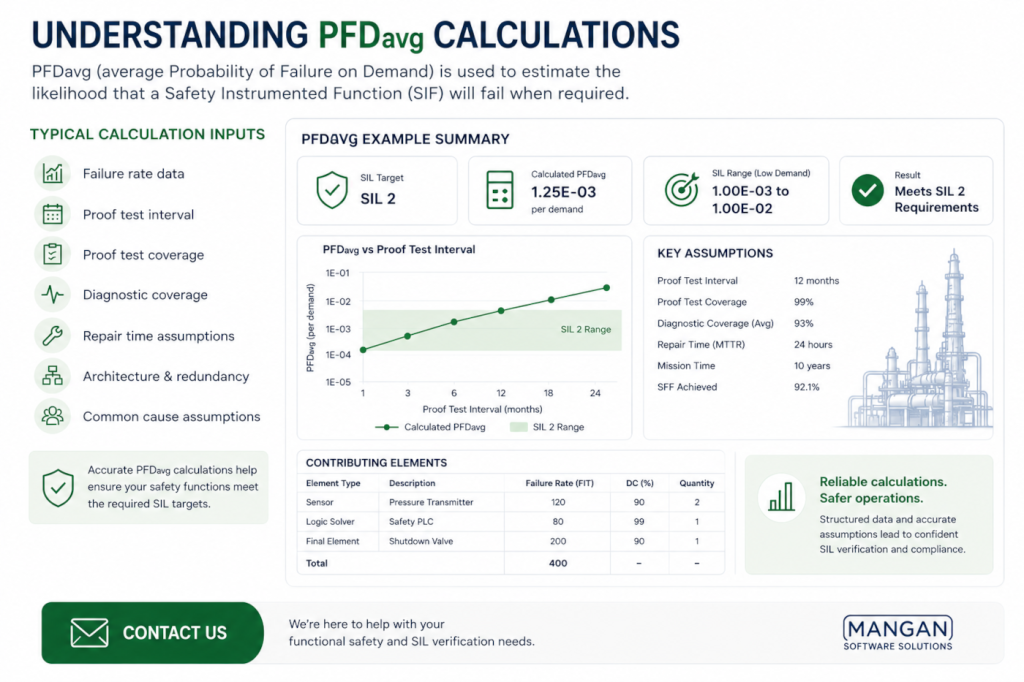
PFDavg means average Probability of Failure on Demand. It is used in functional safety to estimate how likely a Safety Instrumented Function is to fail when required.
Within IEC 61511 projects, PFDavg calculations help engineering teams confirm whether a safety function can achieve its required Safety Integrity Level.
The calculation is influenced by factors such as:
- device reliability
- test intervals
- diagnostic coverage
- repair assumptions
- architecture
- common cause failure assumptions
For more background on lifecycle verification activities, review our SIL Verification guide.
Understanding PFDavg Calculations
PFDavg calculations are commonly used for low-demand safety functions where systems may only be required to respond during hazardous events.
A lower value generally indicates a more reliable protection function.
Typical calculation inputs include:
- failure rate data
- diagnostic coverage
- repair time assumptions
- testing intervals
- architecture and redundancy
- common cause assumptions
Diagnostic coverage can influence PFDavg calculations because detected failures may be identified and repaired before they affect safety function performance. Review our Diagnostic Coverage Explained guide.
Accurate calculation records help organizations improve consistency across lifecycle verification activities.
Logic solvers are often included within PFDavg calculations because controller architecture, diagnostics, and redundancy assumptions influence overall safety function reliability. Explore our
Logic Solvers in Functional Safety Explained guide.
Proof test coverage directly affects PFDavg calculations because incomplete testing may leave dangerous failures undetected between proof test intervals. Explore our Proof Test Coverage Explained guide.
How PFDavg Supports SIL Verification
Engineering teams use PFDavg results to determine whether the proposed safety function design can meet the required SIL target.
This process supports:
- SIL verification activities
- lifecycle documentation
- compliance evidence
- engineering consistency
- risk reduction analysis
- design review processes
For additional verification background, explore our Proof Testing guide.
Key Reliability Factors Within a Safety Function
Several engineering and operational factors can affect reliability calculations throughout the safety lifecycle.
These may include:
- sensor reliability
- logic solver performance
- final element reliability
- testing frequency
- repair procedures
- device diagnostics
- redundancy architecture
For more detail on safety function architecture, see our Safety Instrumented Function (SIF) guide.
PFDavg and IEC 61511 Compliance
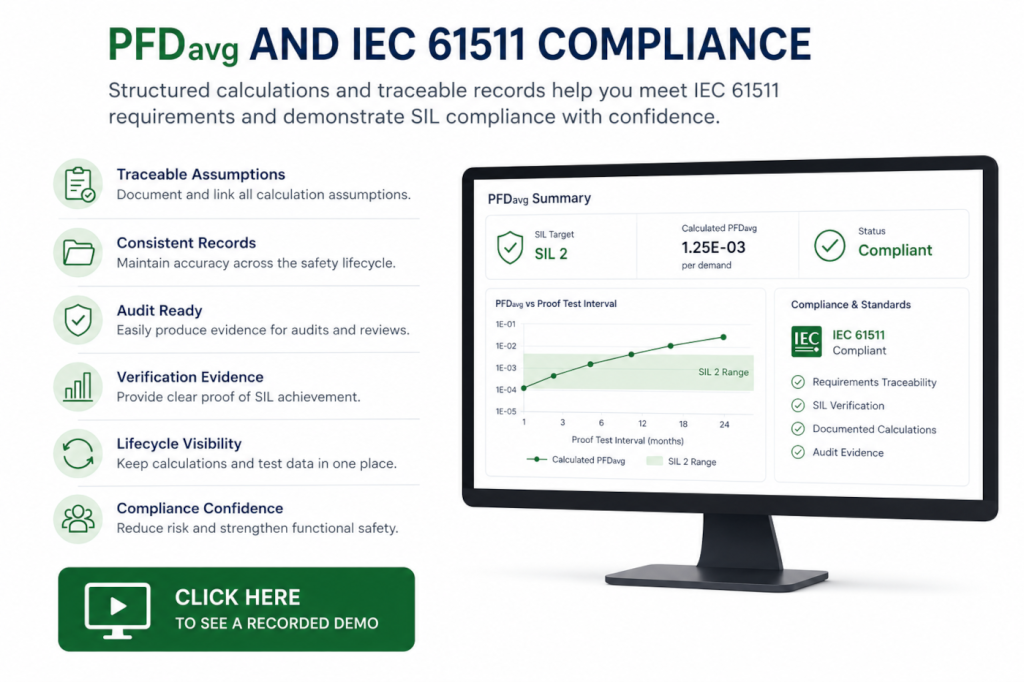
IEC 61511 requires organizations to demonstrate that safety instrumented functions can achieve their required integrity targets.
Structured calculation processes help organizations maintain:
- traceable assumptions
- consistent lifecycle records
- audit readiness
- verification evidence
- engineering visibility
- compliance documentation
For official standards background, visit the IEC Functional Safety overview.
Connecting Calculations to Lifecycle Testing
Lifecycle testing intervals directly influence reliability calculations because dangerous undetected failures may remain hidden between maintenance activities.
Organizations often connect calculation assumptions to:
- test schedules
- maintenance records
- SIF architecture data
- verification assumptions
- repair activities
- audit evidence
For more lifecycle testing context, review our Proof Testing guide.
Managing Reliability Data Across the Lifecycle
Many organizations still manage reliability calculations using disconnected spreadsheets and manual engineering records.
This can create challenges such as:
- version control problems
- manual data entry errors
- limited traceability
- inconsistent assumptions
- poor audit visibility
- duplicate engineering effort
As lifecycle complexity increases, maintaining reliable calculation records manually can become difficult.
Improving Lifecycle Visibility with Structured Software
Structured lifecycle management platforms can help organizations centralize reliability calculations, verification records, and maintenance information within one connected environment.
This may improve:
- engineering consistency
- audit preparation
- workflow management
- document traceability
- reporting visibility
- cross-discipline collaboration
For broader lifecycle management context, explore our Functional Safety Management Software guide.
Linking Reliability Calculations to the SRS
Calculation assumptions should remain connected to the Safety Requirements Specification because the SRS defines the required safety function performance expectations.
This helps organizations maintain alignment between:
- SIL targets
- SIF descriptions
- testing assumptions
- safe-state requirements
- equipment architecture
- maintenance expectations
For more detail, review our Safety Requirements Specification (SRS) guide.
Supporting Long-Term Functional Safety Management
PFDavg calculations should remain part of the ongoing lifecycle because equipment assumptions, maintenance intervals, and operational conditions may change over time.
Lifecycle teams often review calculation records during:
- management of change activities
- equipment replacement
- verification updates
- testing strategy reviews
- functional safety assessments
- compliance audits
For related target-setting context, see our SIL Determination guide.


